Are you a Gear or a Field - MAC143

 PocketCasts
 Apple Podcasts
 Amazon Music
 Spotify
 Castro
 YouTube
 RSS Feed
 Deezer
 Gaana
Gaana 
 PlayerFM
 JioSaavn
 Picture this. You've just been promoted. You earned it — you were the best at what you did, and everyone knew it. The first few weeks feel like validation. Then, slowly, things start to feel wrong. Not catastrophically wrong. Just off. You're working as hard as you ever have, maybe harder, and somehow getting less done. The decisions that used to feel clean are murky. The problems that used to resolve in hours are sitting on your desk for weeks. You're not failing. But it doesn't feel like succeeding, either.
That experience is one of the most common, and most disorienting, transitions in professional life. And it has nothing to do with whether you're talented. It has to do with the fact that the tool you were rewarded for mastering is no longer the tool the job requires — and nobody told you the swap happened.
This episode came out of a LinkedIn post by Jackie Simon, a PCC-certified leadership coach whose career writing I've referenced before on this show — back in Episode 12, Episode 50, and Episode 66. She described a leader she was coaching who had moved into a VP of People role. Same company, same team, same sharp instincts that had made her exceptional. And for months, she kept trying to be a gear when her job had become a field. That single line — gear versus field — is the cleanest description I've found for the thing that quietly derails so many good careers. So let me unpack it, push it further than the original metaphor goes, and then walk it through every stage of a career.
The gear.
A gear works through direct contact. It turns, it drives, it produces. The faster and harder it works, the more impact it creates. That is how most high performers operate early in their careers, and it works — it's supposed to work. The gear is not a failure mode. It is the correct mode for a significant stretch of your professional life. If you're an individual contributor, your value is almost entirely in what you personally produce: speed, precision, individual excellence. The gear is the tool, and you are right to sharpen it.
There's a concept that's been in management theory since 1969 — Dr. Laurence Peter's Peter Principle. The idea is that organizations promote people based on performance in their current role rather than aptitude for the next one, so people keep getting promoted until they reach a level they can't perform at, and there they stay. It sounds harsh, but it's a description of a system, not a judgment on the people inside it. And here's the part that matters: the Peter Principle isn't about incompetent people. It's about competent people who were never taught that the tool changes. You were excellent with the gear. The organization rewarded you for it. You got promoted. And then nobody told you the new role requires something entirely different. That's the gear trap.
The field.
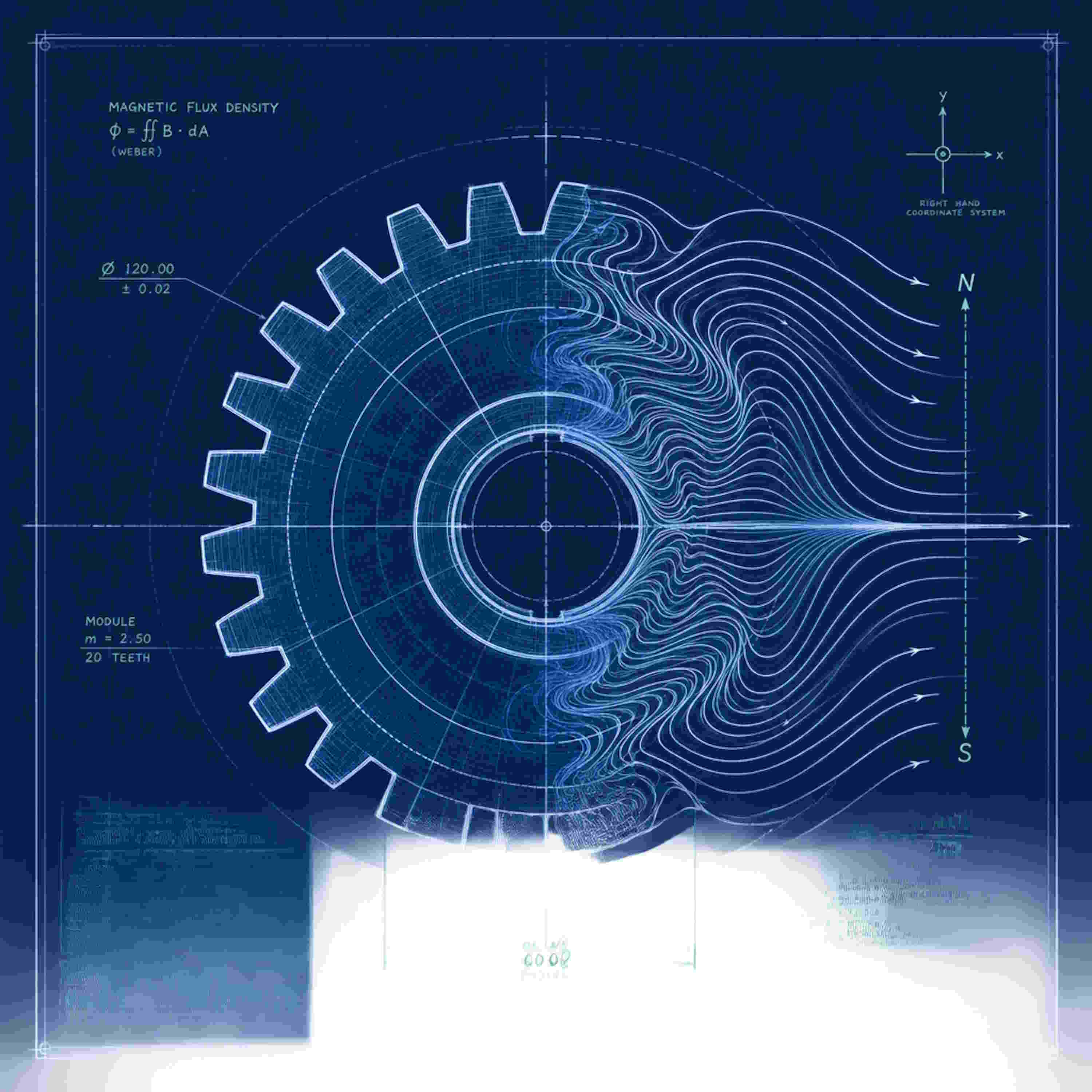
So what's the alternative? Jackie's framing is the cleanest I've heard. A magnetic field doesn't touch everything directly. It changes what's possible in the space around it — silently, indirectly, at scale. That's the shift: from creating impact through contact to creating impact through presence.
I want to push on the physics, because there's more in it worth unpacking. A gravitational field — the field around a planet, or a star — runs on two variables. The first is mass. The more mass an object has, the stronger its field and the further that field extends. A small rock in space has almost no field. A star has a field so powerful it bends light. The second variable is proximity, and this is where it gets interesting. Gravitational field strength doesn't just decrease with distance — it decreases with the square of the distance. Double your distance from the source and the field is only one quarter as strong; triple it and it drops to one ninth. This is the inverse square law, and the field doesn't fade gradually — it falls off fast.
Translate that into organizational terms. Your field — your influence, your presence, your ability to shape what happens around you — is a product of two things: the mass you've built over time, and the proximity of the people you're trying to move.
Your organizational mass is your accumulated credibility. It's the track record of problems you've solved, commitments you've kept, people you've developed, and trust you've earned. You don't build it overnight. You build it over years, across teams, across difficult moments you handled well. Every time you delivered when it mattered, every time you told the truth when it would have been easier not to, every time someone looked to you in a hard moment and found you steady — that added to your mass.
And proximity means the people closest to you feel your field the strongest. Your direct team feels it intensely: every mood shift, every change in priority, every decision you make or don't make, they feel immediately. Your skip-level peers feel it somewhat. People three layers away feel only a fraction of what your direct reports experience. That's not a flaw in the system. That's physics — and it has a practical implication most leaders get exactly backward. When leaders feel their influence isn't reaching far enough, the instinct is to reach harder: push more, get into the weeds, apply more gear. But a gear only works through direct contact, and you cannot scale direct contact to an entire organization. The more you push from a distance, the more friction you generate, and the more your actual reach collapses. The field doesn't push. It changes what's possible in the space — and the way you extend its reach isn't to stretch further yourself, it's to develop other field generators within each proximity ring. (If you want the deeper treatment of leading without direct authority, this idea of influence without authority is the broader discipline underneath it.)
Every career stage.
This shift doesn't happen once. It happens multiple times, at different scales, and missing it at any stage costs you. Stay with the gear and the field — one question at a time: at each stage, are you creating impact through contact, or through presence?
Stage one — individual contributor. You are the gear, and that's exactly right. Your job is to produce, and the faster and more precisely you turn, the more you contribute. This is the stage where working harder genuinely creates better outcomes. Build your craft, deepen your skills, deliver consistently. The one thing to watch: even here, the people with the best long-term trajectories aren't only building technical skill. They're building relational credibility — showing up on time, keeping their word, making life easier for the people around them. That's early-stage mass. It may not feel like much yet. It adds up.
Stage two — senior IC or technical lead. Here the gear starts to feel the pull of something larger. You're still expected to produce, but your choices now affect other people whether you intend them to or not. The way you handle a conflict, the standard you set for your own work, the way you engage in a meeting — all of it creates conditions for the people around you. This is the edge of the gear becoming a field. You're not managing anyone, but you are influencing, and the best people learn to do it on purpose.
Stage three — first-time manager. This is where careers most often stall. You were promoted because you were the best gear in the shop, and nobody told you the job fundamentally changed. The instinct is to keep doing the work — it's faster, it's cleaner, the quality is right. But every time you do the work that belongs to your team, two things happen: the work gets done your way today, and your team learns a little less for tomorrow. You become the bottleneck. There's also a structural trap here. If you are indispensable to every critical function in your current role, you cannot be promoted out of it — the organization literally can't afford to move you, because no one is ready to replace you. Your indispensability becomes your ceiling, and that's a gear problem, not a talent problem. The shift signal: measure your success by what your team produces, not by what you produce. If those two numbers aren't diverging, you're still in gear mode.
Stage four — mid-level manager or director. The field is now required. You're not managing tasks — you're managing conditions: setting direction, clearing obstacles, aligning incentives, developing the people below you into leaders who can run their own fields. A field without alignment is just noise, and directors still in gear mode create chaos at scale by making micro-decisions across too many domains — every one of which prevents someone beneath them from developing the judgment to make those decisions themselves. A director doing the job well is almost invisible in the day-to-day, because the systems and people they've built run without them. Your job here is to build the mass in your managers so their proximity rings are covered and your overall field reaches further.
Stage five — VP and above. At this level, you are the field. I've watched senior leaders walk into a meeting and change the temperature of the room before they said a word. Their field is so strong, and the proximity of everyone in that room so close, that even their presence is a force — the way they sit, whether they look calm or concerned, which voice they acknowledge first. That's not charisma. That's mass, built over years, combined with proximity. And it cuts both ways: a leader who is anxious amplifies anxiety; a leader who is unfocused gives the whole organization permission to drift. The field generates what it contains. The paradox is that the higher you go, the more your direct reach shrinks even as your influence extends — if you've built the right structure beneath you. The inverse square law means you can't cover the whole organization yourself. What you can do is develop the leaders who develop the leaders who develop the people.
The long arc — from rock to star.
The gear and the field answer one question: how are you creating impact right now — through contact, or through presence? It's almost a switch you flip at each stage. But there's a second question those two can't touch: not how you create impact, but how much, and how far. For that, hold the whole career in a single image built on those same two variables, mass and proximity.
Early on, you're a cluster of asteroids. Any single piece of rock is negligible. But mass accumulates — every problem solved, every commitment kept, every bit of trust earned is another fragment pulled into the pile. Nothing orbits you yet, and you're not trying to make it. You're just getting denser. Keep at it and the cluster compacts into a single body heavy enough that its gravity reaches the rocks nearest it. You're still drifting locally, still one object among many, but no longer inert — the things closest to you start to feel your pull whether you intended it or not.
Keep going and the asteroid becomes a moon. It leaves the loose rubble and settles into orbit around something larger than itself — a team, a function, a mission. A moon carries enough mass to raise tides; its influence is felt across a body far bigger than it is. Keep going and you become a planet. Now things orbit you — people, priorities, decisions settle into stable paths around your gravity, and the work stops being to chase each one and becomes to stay massive and steady enough that the orbits hold on their own. And at the far end of the arc, a star: mass so great it doesn't just hold things in orbit, it bends light itself. That's the senior leader who changes the temperature of a room before speaking, whose field is strong enough to curve the path of things that, by every intuition, should have traveled straight.
Here's what this image shows you that the gear and the field never could. A star, for all its mass, still can't warm the whole galaxy — its light falls off with the square of the distance, and the outer reaches barely feel it. You cannot grow your own mass large enough to reach everyone; it isn't a matter of effort, it's geometry. The only way the light gets to the edges is if there are other stars out there. So the greatest thing mass can do is not to become a bigger star. It's to ignite new ones — to build enough mass in the people around you that they begin to bend their own corner of space, and warm the parts of the organization you were never going to reach alone.
And notice how differently that arc behaves from the gear and the field. Becoming a field was a genuine switch — you had to stop pushing and start shaping. But mass never switches. It only ever accumulates. Nothing you built as a cluster of rock was wasted; it's all still in there, part of what now lets you bend light. The gear and the field tell you what to change. The arc tells you that nothing you've built is ever lost.
How to know which mode you're in.
Three questions. First: when something goes wrong on your team, is your first instinct to fix it, or to ask who on your team should fix it? A gear fixes; a field develops the people who fix. Second: when you take a day off, does work slow down or stop? A gear creates bottlenecks; a field creates systems that run without direct contact. Third: what's the ratio of problems you're solving versus problems you're equipping others to solve? If most problems still come to you for a final answer, you're still the gear, regardless of your title. These aren't pass-fail questions — they're diagnostic. The goal isn't to feel bad about where you are. It's to see where the shift needs to happen so you can be intentional about making it.
Your action plan. First, identify your current stage — not your title, your actual operating mode. Are you producing, or enabling? Are you the gear, or generating a field? Most people are a mix, and the mix tells you where the work is. Second, name one gear behavior you're holding onto — the work you keep doing because it's faster yourself, the decision you keep making instead of letting your team make it — and put that one down this week. Third, make one mass-building move: develop someone, keep a hard commitment, solve a cross-functional problem that wasn't technically yours, or be the steady voice when everyone else is anxious. Small deposits. Over time, they become a field.
I'll end where Jackie Simon ended her original post: the behaviors that got you here haven't become wrong. They've become misdirected. You don't need to throw out everything you've built. The gear isn't broken — it's just the wrong tool for the job you now have. And learning to generate a field isn't a soft skill. It's a survival skill. It's the thing that separates the people who plateau from the people who keep growing.
TAKE THE SURVEY!
Are you looking for a career coach? If you reach out to me via the contact form, I will arrange an introductory session where we can talk about your career goals and how I can help. If we're a good fit, we can schedule regular coaching sessions.